




Kopili River Resumes Cargo Movement After a Decade with Maiden Cement Shipment

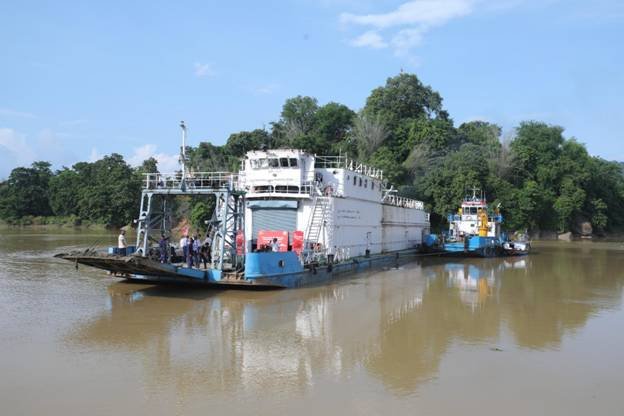
In a significant stride towards bolstering Assam’s river-based trade and sustainable logistics, National Waterway-57 (River Kopili) has been officially operationalised. This landmark event, which took place on August 2 (Saturday), saw the first-ever cargo trial run from Govardhan Bridge in Chandrapur, Kamrup, to Hatsingimari in South Salmara, signalling the resumption of intra-state waterborne freight transport in Assam after more than a decade.

The Union Minister for Ports, Shipping & Waterways, Sarbananda Sonowal, hailed this development as a “watershed moment” for Inland Waterways Transport in Assam and the Northeast. The cargo vessel MV VV Giri, equipped with self-loading capabilities, embarked on its journey carrying 300 metric tonnes of cement from M/s Star Cement along the 300-kilometre route on the Kopili River (NW-57) and the Brahmaputra River (NW-2), with an estimated voyage time of 12 to 14 hours. This achievement brings the total operational National Waterways in Assam to over 1,168 kilometres, as confirmed by Sarbananda Sonowal.

“This is a watershed moment for Assam,” Sarbananda Sonowal stated. “With the operationalisation of NW-57 on River Kopili, we are not only reviving a lost artery of trade within the state, but also taking a major step towards building an inland water transport system that is economical, efficient, and environmentally sustainable. For far too long, the rich inter web of riverine transportation remained neglected post independence. Today, with the resumption of cargo movement on four National Waterways of Assam — on Brahmaputra (NW-2), Barak (NW-16), Dhansiri (NW-31) & Kopili (NW-57) — we have made 1168 kms of waterways operational, offering a reasonable, economic and effective alternative mode of transportation. This will not only decongest our roads but also bring economies of scale for our many riverine communities in Assam to prosper and secure opportunities.”

The Union Minister further elaborated on the broader vision driving this initiative. “Under the visionary leadership of Prime Minister Narendra Modi, the Government of India has placed a strong focus on revitalising our inland waterways to create multimodal logistics corridors. Assam is an important state in this regard as IWAI, the nodal agency of our ministry, is working on multiple projects to unlock value across our river ways. From Brahmaputra to Barak, from Dhansiri to now Kopili, this is only the beginning to power the growth of the region with empowered inland waterways. Reviving waterways like the Kopili is a direct contribution to Modiji’s vision of a thriving and self-reliant Northeast,” Sarbananda Sonowal affirmed.

Highlighting the practical benefits of this modal shift, the Union Minister noted, “By shifting freight movement from road to waterways, we reduce emissions, ease road congestion, and lower logistics costs — all while making better use of our natural resources. Today’s trial run replaces roughly 23 truckloads of cement — that’s the power and potential of inland water transport.”

This inaugural cargo trial on the 46 km long NW-57 marks a pivotal moment in the revival of intra-state cargo movement through Assam’s river systems. The operationalisation of this route aligns with the overarching goals of Maritime India Vision 2030 and PM Gati Shakti, which aim to establish sustainable, integrated, and efficient transport infrastructure across the country. The Inland Waterways Authority of India (IWAI), operating under the Ministry of Ports, Shipping and Waterways, continues its proactive efforts to unlock the navigational potential of rivers throughout the Northeast.

Sarbananda Sonowal concluded by emphasising the broader impact: “The Kopili cargo movement is a symbol of the new Assam — connected, empowered, and aligned with India’s growth story. We are determined to build on this success and scale up cargo and passenger movement across all our major rivers. Waterways are not just a mode of transport; they are the arteries of regional prosperity.”
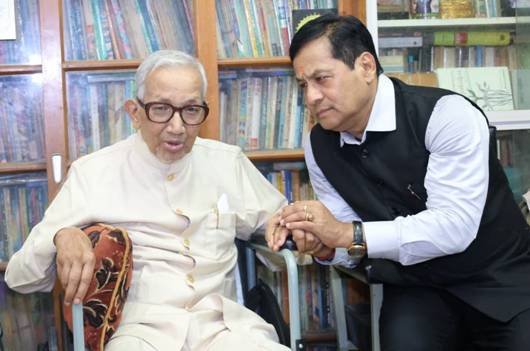

Union Minister Sarbananda Sonowal calls on Eminent Scholar, Litterateur Dr. Nagen Saikia in Dibrugarh

The Union Minister for Ports, Shipping and Waterways, Sarbananda Sonowal called on eminent scholar, litterateur and thinker Dr. Nagen Saikia at his residence in Dibrugarh to enquire about his well-being and engage in a conversation on various topics.

Wishing Dr. Saikia good health and a long life, Sonowal said, “The philosophy and invaluable contributions of Dr. Nagen Saikia have enriched national life and continue to inspire the younger generation. It was a privilege to meet him, seek his blessings, and benefit from his wise counsel. His words have been truly inspiring.”

Former Mali Prime Minister Moussa Mara Detained Amid Crackdown on Dissent

0

Moussa Mara, a former Prime Minister of Mali, has been taken into pretrial detention following a social media post in which he expressed solidarity with jailed critics of the ruling military junta. His arrest, which occurred on August 1 (Friday), marks the latest move in a series of crackdowns on dissent by the West African nation’s military leadership. The news was widely reported on August 2 (Saturday), by the media.

Mara, who served as Prime Minister from 2014 to 2015, was reportedly arrested after a cybercrime prosecutor ordered his detention. According to his lawyer, Mountaga Tall, Mara faces charges including undermining state authority, inciting public disorder, and spreading false information. His trial is scheduled to begin on September 29 (Monday).

The former Prime Minister’s detention comes after he posted on social media on July 4 (Friday), stating that he had visited jailed critics of the military junta and vowed to fight for their justice. This public expression of support appears to have triggered the legal action against him.

Mali has been under military rule since General Assimi Goïta orchestrated two coups in 2020 and 2021. Despite earlier promises of a return to civilian rule, Goïta was granted an additional five years in power in June. This extension followed the military regime’s dissolution of political parties in May, a move that has been widely criticised by human rights organisations and international bodies.

Mara’s arrest is seen as a further tightening of control by the junta, particularly after the country witnessed its first pro-democracy rally in nearly four years. The ongoing political instability and the military’s suppression of opposition voices continue to be a significant concern for observers of the West African nation.

Moderate Earthquake Shakes Pakistan, No Major Damage Reported

0

A 5.4-magnitude earthquake struck various parts of Pakistan in the early hours of August 2 (Saturday), causing widespread tremors and prompting residents to evacuate their homes. Despite the initial panic, authorities have confirmed that no significant loss of life or property has been reported. 

The earthquake occurred at approximately 2:04 AM Pakistan Standard Time (PST), with its epicentre located in Afghanistan’s Hindukush mountain region at a depth of 102 kilometres, according to the National Seismic Monitoring Centre (NSMC). Tremors were felt across a broad area, including major cities such as Islamabad, Rawalpindi, Lahore, and Peshawar, as well as numerous districts in Khyber Pakhtunkhwa and Punjab.

Residents in affected areas reported being woken by the shaking and, as a precautionary measure, many rushed outdoors. Pakistan is situated in a seismically active zone where the Indian and Eurasian tectonic plates converge, making the region susceptible to frequent seismic activity.

Following the event, the Provincial Disaster Management Authority (PDMA) confirmed that its Emergency Operations Centre is actively monitoring the situation and remains in contact with district administrations across affected regions. Citizens have been urged to report any emergencies through the PDMA helpline.

It is worth noting that a milder 4.8-magnitude earthquake also struck parts of Pakistan just after midnight on August 3 (Sunday), further highlighting the ongoing seismic activity in the region.

England Face Historic Chase as India Seeks Series-Levelling Win at The Oval

0

The fifth and final Test between England and India at The Oval is poised for a thrilling conclusion as Day 4 dawns on August 3 (Sunday). India concluded Day 3 in a commanding position, setting England a challenging target of 374 runs for victory. At stumps on August 2 (Saturday), England stood at 50 for 1, requiring a further 324 runs with nine wickets in hand to level the series.

Day 3 witnessed India’s batting prowess, transforming a precarious situation into a dominant one. Resuming their second innings on 75 for 2, India amassed a formidable total of 396. The innings was anchored by a superb century from opener Yashasvi Jaiswal, who scored 118. He received excellent support from nightwatchman Akash Deep, who made an impressive 66, along with valuable half-centuries from Ravindra Jadeja (53) and Washington Sundar (53). England’s bowlers toiled hard, with Josh Tongue being the pick of the attack, claiming five wickets.

Earlier in the match, on August 1 (Friday), India were bowled out for 224 in their first innings. England then secured a 23-run lead by scoring 247, with notable contributions from Zak Crawley (64) and Harry Brook (53). India’s pace attack, spearheaded by Mohammed Siraj and Prasidh Krishna, who both took four wickets, helped to restrict England’s first innings total after a strong start.

The final moments of Day 3 delivered a crucial blow to England’s chase when Mohammed Siraj dismissed opener Zak Crawley for 14. This late wicket has put immense pressure on the English batting line-up as they head into Day 4.

England now face a monumental task. The highest successful fourth-innings chase at The Oval stands at 263, a record set way back in 1902. To achieve their target, England will need to surpass this historic benchmark by a significant margin, demanding exceptional batting performances and composure.

The pitch at The Oval has offered assistance to bowlers throughout the match, and India’s pace attack, coupled with their spin options, will be looking to exploit any remaining movement and cracks. With the series on the line, Day 4 promises to be a captivating contest as England attempts a record-breaking chase, while India pushes for a series-levelling victory.

Assam Concludes First Phase of Major Forest Eviction Drive, Reclaiming Over 10,000 Bighas

The Assam Forest Department has successfully concluded the first phase of a significant eviction drive in the Rengma Reserve Forest in Uriamghat, Golaghat district. The operation, which spanned five days, resulted in the reclamation of over 10,000 bighas (approximately 1,300 hectares) of forest land and the demolition of around 4,000 structures.

This extensive drive, one of the largest undertaken by the state government, aims to free government and forest lands from encroachment. An MLA overseeing the operation confirmed the completion of this initial phase.

The eviction targeted alleged illegal settlements within the Rengma Reserve Forest, an area close to the Assam-Nagaland border. Reports indicate that approximately 2,000 families, primarily from the Muslim community, had been residing in these encroached areas. While many families voluntarily vacated the land after receiving prior notices, authorities proceeded with the demolition of remaining structures, including commercial establishments and residential buildings.

The Assam Chief Minister has publicly stated that such eviction drives are conducted in a “well-thought-out, legally sound, and systematic manner.” He emphasised the government’s commitment to reclaiming encroached forest lands, grazing grounds, and land belonging to religious institutions, asserting that these actions are crucial for ecological conservation and to curb illegal activities. The Chief Minister also noted that the government differentiates between unauthorised occupation by indigenous people and encroachments by “foreigners and doubtful citizens,” with the latter being the primary target of these drives.

The operation involved a substantial deployment of security forces, including personnel from the Assam Police, Central Reserve Police Force (CRPF), and the Forest Department, ensuring a largely peaceful execution. The reclaimed land is slated for ecological regeneration initiatives.

While the government maintains that the drive is essential for environmental protection and upholding land laws, some affected families have questioned the rationale, claiming they were settled in the area by previous governments. The All Rengma Welfare Organisation has publicly lauded the Assam Chief Minister for the eviction drive, calling it a “significant step” towards restoring justice and protecting the long-standing indigenous rights of the Rengma Naga community.

Unidentified Drone Sparks Border Security Inquiry in Tripura

A “Made in China” drone, equipped with high-resolution cameras, was recently discovered near the India-Bangladesh border in Tripura, prompting a joint investigation by the Border Security Force (BSF) and Tripura Police. The incident, widely reported by the media, has raised questions about border surveillance and security in the sensitive region.

The drone, weighing approximately 915 grams, was found on August 1 (Friday) by a young boy in a paddy field near the Durgabari Border Outpost, roughly 650 metres from the international boundary. Unaware of its significance, the boy reportedly took the drone home and cleaned it. His family subsequently informed the authorities, leading to swift action.

Following the alert, Tripura Police took custody of the device and immediately sent it to the state government’s Forensic Science Laboratory (FSL) for examination. A BSF official stated that after the FSL analysis is complete, the drone will be transferred to the BSF headquarters in Delhi for a more comprehensive technical and intelligence assessment. The official also mentioned that it is “not yet clear from where the drone came into the Indian territory,” and that further details would emerge after a thorough investigation.

The presence of an unidentified drone near the international border has heightened security vigilance, particularly given the ongoing political situation in neighbouring Bangladesh and the general sensitivity of the region. Tripura shares an 856 km border with Bangladesh, making it susceptible to various cross-border activities. Security forces have already intensified patrolling and surveillance along the frontier.

Centre Extends ‘Disturbed Area’ Status in Eight Nagaland Districts Under AFSPA

The Union Ministry of Home Affairs (MHA) has extended the declaration of eight districts in Nagaland as ‘disturbed areas’ under the Armed Forces (Special Powers) Act (AFSPA), 1958. This extension, effective from April 1 (Tuesday), will remain in force for a period of six months, unless withdrawn earlier.

The districts affected by this extension include Dimapur, Niuland, Chümoukedima, Mon, Kiphire, Noklak, Phek, and Peren. Additionally, areas falling under the jurisdiction of 21 police stations across five other districts of Nagaland will also continue to be designated as ‘disturbed areas’. This decision follows a review of the law and order situation in the state by the Central government.

AFSPA grants sweeping powers to armed forces operating in these ‘disturbed areas’, including the authority to search, arrest without a warrant, and open fire if deemed necessary for the maintenance of public order.

The extension has drawn strong criticism from various Naga civil society organisations. The Naga Students’ Federation (NSF) has publicly condemned the move, calling it a “blatant affront to the dignity, rights, and democratic aspirations of the Naga people.” The NSF stated that the extension is an “unjust and regressive move that disregards the realities on the ground” and criticised the government for continuing to “militarise our land and impose colonial-era laws that empower security forces.” The Federation reiterated its demand for the immediate and complete repeal of AFSPA from the Naga homeland.

Meghalaya Launches Full Investigation into Missing Coal Stockpile

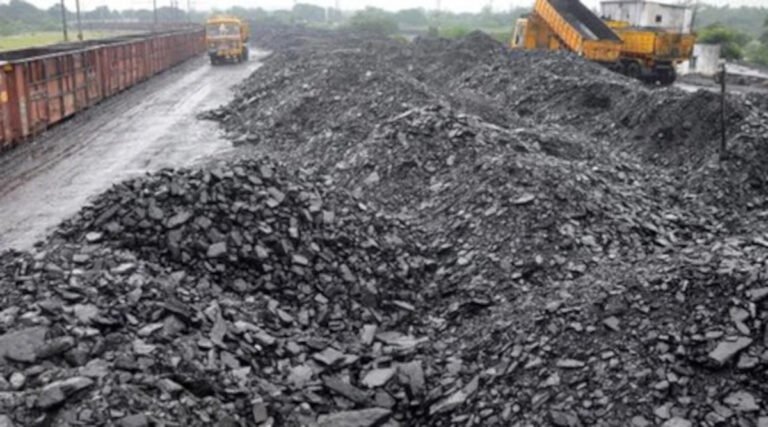
The Meghalaya government has initiated a comprehensive probe into the alleged misappropriation of over 4,000 metric tonnes of coal. The investigation, directed by Deputy Chief Minister Prestone Tynsong, comes in the wake of a report from a High Court-appointed committee that highlighted the disappearance of a significant coal stockpile. The news was widely reported on August 2 (Saturday), by the media.

Deputy Chief Minister Tynsong, who also holds the Home portfolio, confirmed that instructions have been issued to all district authorities and police to conduct a thorough inquiry. “We have asked deputy commissioners and superintendents of police to investigate if there has been any misappropriation or illegal diversion of coal,” Mr. Tynsong stated publicly. He further added that if any wrongdoing is confirmed, action will be taken according to the law, and the government is prepared to approach the Supreme Court if necessary.

The missing coal was reportedly from two designated storage sites in Ri-Bhoi and West Khasi Hills districts, where it had been declared as extracted and inventoried. The High Court-appointed Justice (retired) B.P. Katakey Committee’s interim report raised serious questions about the state’s coal inventory monitoring and enforcement mechanisms, particularly concerning illegal mining and transportation.

The state’s probe will focus on tracing both coal and diesel inventories, examining transportation logs, consignment documentation, and the roles of various departments involved. A comprehensive report on the findings is expected to be submitted to the High Court in due course. This development underscores the ongoing scrutiny over coal mining practices in Meghalaya, which has been under a ban on unscientific rat-hole mining since 2014 by the National Green Tribunal, with conditional mining allowed later under strict guidelines.

Guwahati Braces for Heavy Rainfall and Thunderstorms

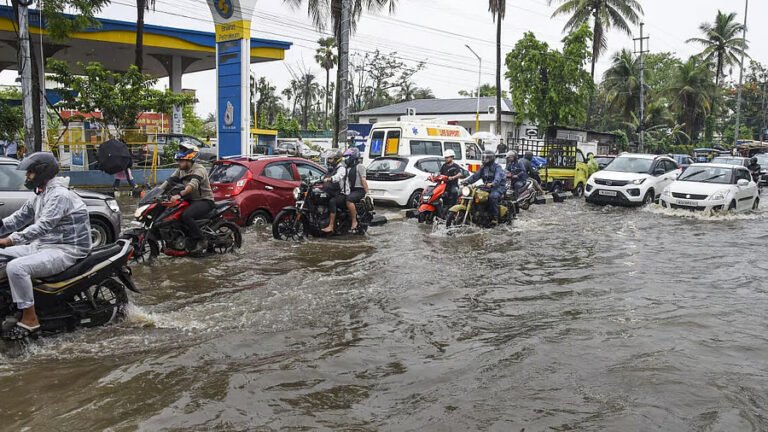
The India Meteorological Department (IMD) has issued a forecast for heavy to very heavy rainfall, accompanied by potential thunderstorms and lightning, for Guwahati over the next two to three days. This alert, released on August 2 (Saturday) prompts heightened vigilance across the city.

The IMD’s prediction indicates that isolated areas within Guwahati could experience rainfall ranging from 7 to 11 cm within a 24-hour period. Furthermore, thunderstorms with lightning and gusty winds, reaching speeds of 40 to 50 kmph, are also anticipated in isolated pockets. These weather conditions are expected to exacerbate waterlogging in low-lying areas, impede vehicular movement, and increase the risk of localised landslides, particularly in vulnerable hillside zones.

In response to the evolving weather situation, the Assam State Disaster Management Authority (ASDMA) has urged residents to exercise extreme caution. Emergency response systems have been placed on standby, and city authorities are actively monitoring developments to manage any challenges that may arise.

The ASDMA has advised daily commuters and long-distance travellers to plan their routines accordingly and to avoid unnecessary movement during periods of intense rainfall. Residents living in flood-prone and hilly areas are particularly cautioned to remain alert for any signs of flooding or landslides. The public is encouraged to stay tuned to official weather updates and adhere strictly to safety advisories issued by local authorities to ensure safety throughout this prolonged spell of rain. The ASDMA has assured that it will provide regular updates for public awareness.