Beyond the Usual: Hidden Homestays and Eco-Retreats in the Northeast

0

In the far-flung corners of the country (well, no so far-flung anymore), the Northeast offers a wealth of unexplored beauty and cultural richness. While travelers are familiar with tourist magnets like Shillong or Kaziranga, much of the Northeast still exists in a state of serene anonymity. It is in these untouched landscapes where some of the most unique homestays and eco-retreats are nestled—hidden havens run by locals, often rooted in sustainability and tribal traditions. These are not just places to stay; they are windows into a way of life that remains harmoniously connected with nature.

Chapter 1: Into the Bamboo Valleys of Arunachal

Tucked away in the hills of Ziro, Arunachal Pradesh, a small homestay called Donyi-Polo Trails welcomes guests with bamboo-floored cottages, Apatani meals served on leaf plates, and views that stretch endlessly across pine-covered hills. The host, Rutu Tamang, a retired forest officer, explains that he built the homestay to preserve the local way of life. “People come here expecting hotels. We give them hearth fires, millet wine, and night skies,” he smiles.

The retreat uses harvested rainwater, solar panels, and bio-waste management systems. Guests participate in farming activities, learn bamboo weaving from local artisans, and trek through pine forests with community guides who share stories of Apatani mythology.

Chapter 2: Forest Living in Tripura’s Jampui Hills

Few travelers venture to the Jampui Hills of Tripura, but those who do often find themselves at Reang Nest, an eco-village built by members of the indigenous Reang tribe. The community-run initiative features mud cottages with thatched roofs and panoramic sunrise views over the Lushai Hills. Days begin with herbal tea brewed from foraged lemongrass, and end with community bonfires where elders recount stories of migration and resistance.

It is not luxury that draws people here, but the authenticity of experience. Guests like Tanya Rao, a documentary filmmaker from Pune, describe it as “an unfiltered look into life in harmony with the land.”

Chapter 3: Rivers, Rain, and Revival in Meghalaya

In the wettest place on earth, Mawsynram, homestays have grown around caves, waterfalls, and sacred groves. A standout is the Skyroot Homestay, run by the Khongsit family. Built entirely from reclaimed wood and stone, it stands near a living root bridge that draws the occasional hiking group. The family includes guests in everyday activities: milking cows, fetching spring water, even joining the Khasi women at the local haat (market).

Tourism has revitalized local pride here. Younger villagers who once considered migrating to bigger cities now help manage logistics, social media pages, and booking platforms. According to the owner, Merila Khongsit, “The income is secondary. We want people to see our way of life and understand it.”

Chapter 4: Nagaland’s Warrior Hospitality

Nagaland’s hill villages once known for their warrior past now welcome guests in homestays that reflect their rich heritage. In the village of Khonoma—India’s first green village—a boutique homestay called Morung Memories offers mahogany-furnished rooms with handwoven throws, overlooking rice terraces.

Hosts Sashi and Naro Kithan, both descendants of the Angami warrior clan, organize night walks through the village where lanterns light up ancient paths. Guests learn how the village uses traditional forest laws and clan consensus to protect their ecosystem.

“The old ways taught us how to take only what we need,” says Naro. “We teach that to everyone who comes.”

In a Nutshell it is a Journey Worth Taking

Hidden homestays and eco-retreats in the Northeast are not about ticking boxes on an itinerary—they are about immersion, understanding, and slowing down. For those willing to step off the beaten path, they offer more than rest. They offer renewal.

Assam Cabinet Approves Key Welfare, Healthcare & Education Moves

In a Cabinet meeting held today at Lok Sewa Bhawan, the Assam government, under the leadership of Chief Minister Himanta Biswa Sarma, approved a series of transformative decisions aimed at welfare, healthcare, education, and rural development across the state.

A key highlight of the meeting was the approval of ₹342 crore under the “Eti Koli Duti Paat” scheme. Approximately seven lakh tea garden workers and employers will receive a one-time grant of ₹5,000 each, as a tribute to the 200-year legacy of Assam’s tea industry. The Chief Minister called the initiative a gesture of gratitude toward a community that has played a foundational role in shaping Assam’s cultural and economic identity.

The Cabinet also gave the green light to the establishment of a Central University for Disability Studies in the Kamrup district. This institution will focus on research, education, and healthcare related to disability and inclusion. Land for the university has already been identified at Deosar under Bongaon Mouza, streamlining the setup without requiring acquisition.

On the healthcare front, a ₹800 crore investment by Medanta Group was approved for setting up a 500-bed hospital in Guwahati. The project will include a 100-bed maternity center and a five-star Lemon Tree Hotel to support medical tourism. The development is expected to create around 2,700 direct jobs and position Assam as a hub for advanced healthcare services.

The Cabinet also cleared the issuance of land pattas to approximately 4,000 historical institutions—such as schools and religious organizations—under Mission Basundhara 3. About 13,000 pending land-related cases are expected to be resolved by the end of July, with formal patta distribution planned in August.

In a significant rehabilitation measure, eleven families evicted from government land in Lakhimpur district will be resettled with free land allotments of 1 katha 5 lessa each.

The Assam Medical College and Hospital (AMCH) in Dibrugarh will undergo a major infrastructure expansion with an investment of ₹357 crore. This will include new hostels, staff housing, nurses’ quarters, and a community hall. Construction is scheduled to begin within the next two weeks.

In response to a nearly 40 percent rainfall deficit in several districts, the Cabinet authorized the Revenue Department to declare drought relief measures in Baksa, Bongaigaon, Barpeta, Dhubri, and Kokrajhar. Dibrugarh and Tinsukia are also facing similar conditions and may receive aid soon.

The Cabinet further extended medical reimbursement benefits to employees of state power utilities and Adarsha Vidyalayas, bringing them in line with regular government staff. Additionally, it was decided that future land access for industrial and oil exploration projects must be negotiated directly with landowners, with the government stepping in only to resolve disputes, streamlining the land acquisition process.

Today’s Cabinet decisions reflect a comprehensive approach to social welfare, economic development, and infrastructure growth, reinforcing the Assam government’s commitment to inclusive progress.

Why Does Guwahati Flood So Often?

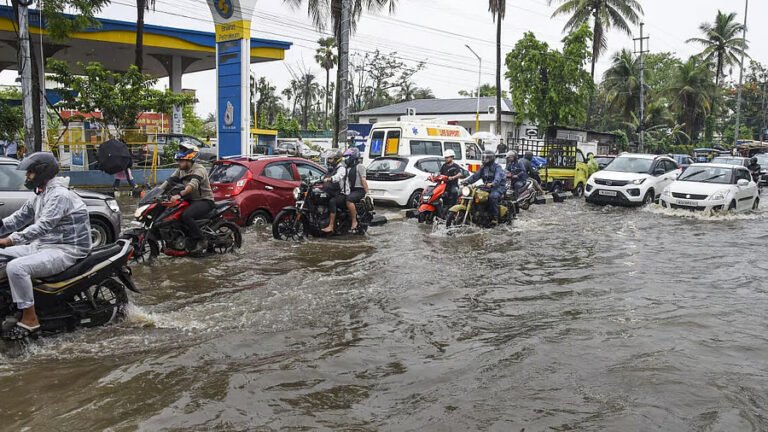
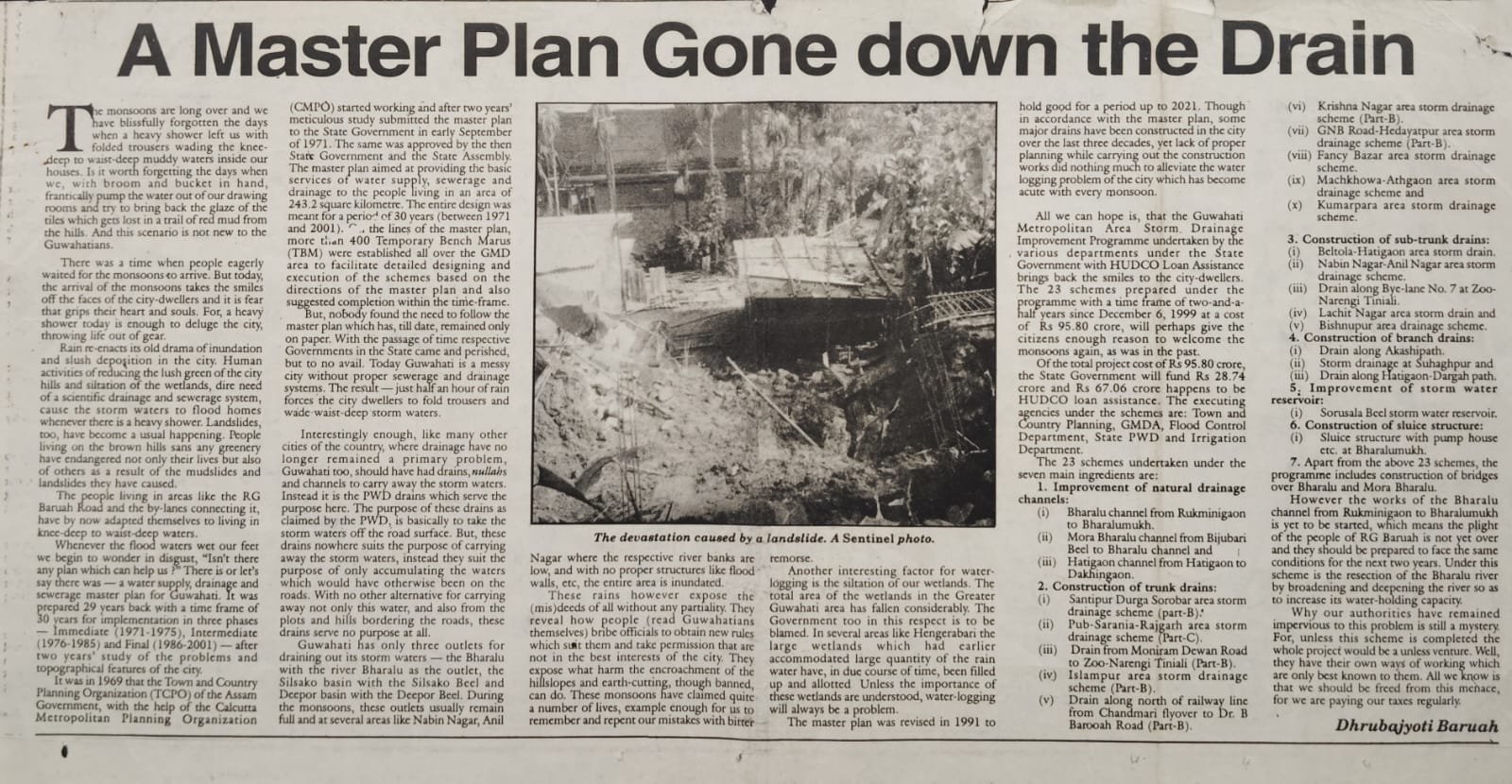
In 1999, a prophetic article titled “A Master Plan Gone Down the Drain” warned that Guwahati’s flood woes would only worsen unless urgent and coordinated action was taken. Written by yours truly, the piece highlighted how areas like Beltola, Rukmininagar, and Wireless—once unaffected by waterlogging—were already inching toward crisis due to poor planning, unchecked hill-cutting, and the absence of modern drainage systems. More than two decades later, the article reads like a blueprint for today’s urban nightmare. Guwahati, once safe from even moderate flooding, now drowns in ankle- to waist-deep water at the slightest spell of rain.

An article on the masterplan of Guwahati city written in 1999

The article detailed how master plans submitted in 1971 and later updated in 1991 were never implemented with commitment. It pointed out how major stormwater channels such as the Bharalu and Mora Bharalu were heavily silted, how the wetlands that acted as natural flood reservoirs were disappearing rapidly, and how successive governments failed to install proper sub-trunk drainage systems and pump stations. These warnings, supported by field observations and technical recommendations, were largely ignored.

Today, the legacy of that neglect is plain to see…

And while USTM in Meghalaya might receive more rainfall than Guwahati, the consequences are felt deeply in the city—where even moderate showers now lead to roads turning into rivers. Guwahati’s persistent flooding reflects not just nature’s force, but serious flaws in planning, drainage, and maintenance.

So why then Guwahati floods so regularly: Positioned in a natural basin bordered by hills and tributaries, Guwahati was once protected by wetlands like Deepor Beel and rivulets such as Bharalu and Basistha. Over time, many of these natural buffers have been filled or encroached upon. Meanwhile, construction on hill slopes causes soil erosion, clogging drains with silt. The city depends on a rudimentary storm drain network designed in colonial times, capable of handling only about 30 mm of rainfall—insufficient when modern monsoons dump over 100 mm within hours. Moreover, a lack of a separate sewerage system means wastewater—often from homes and businesses—is poured directly into storm drains, further clogging them. One environmental activist observed how drain channels are overburdened: “Waste and garbage are thrown into the rivulets, making them unusable for stormwater.”

In neighborhoods including Beltola, Nabin Nagar, and Rukminigaon, what should be brief waterlogging has become daily flooding. Cars are stranded and emergency vehicles stalled. A resident lamented: “It is a daily story for the city… Whenever it rains, our lives come to a sudden halt due to lack of proper planning.” In Rukminigaon, some locals now use inflatable boats to commute because the water rises in minutes. Councillor Swapna Devi from Ambikagiri Nagar, home to over 50,000 people, detailed how uphill hillocks funnel rainwater directly into fragile drains, overwhelming them even after local desilting efforts.

Government Response: Intent Versus Delivery

The Assam government, the Guwahati Municipal Corporation, and the GMDA have collectively launched Mission Flood‑Free Guwahati, a program aimed at desilting drains, protecting wetlands, banning illegal hill-cutting, and enforcing rainwater harvesting in new constructions. Several newly built elevated road-drain combinations in areas like Juripaar divert stormwater toward wetlands like Silsako, showing a potential model for other flood-prone zones.

However, execution has lagged behind intent. Drain cleaning often appears superficial; silt is relocated rather than fully removed, sometimes ending up back in waterways during subsequent rains. Construction norms governing hillside development are unevenly applied, and enforcement remains weak. Desplited stretch regains silt within days. In some cases, political discourse has further complicated matters: some leaders controversially blamed adjacent Meghalaya land use—calling it a “flood jihad”—shifting attention from local systemic failures.

In Perspective: Is Enough Being Done?

While positive steps such as desilting initiatives and road-drain projects exist, they remain patchy and insufficient. Drain clearing is reactive—triggered after floods rather than preventive. Master drainage plans based on scientific watershed analysis remain unimplemented. Sewage continues to contaminate storm drains; without separate sewer infrastructure, drains double as open sewers, reducing their capacity dramatically. Waste dumping—from households and construction sites—remains unchecked.

Advisors and activists advocate for a comprehensive approach: restoring wetlands as flood buffers, engineering rivulets for higher flow capacity, building separate sewage networks, strictly regulating hill-cutting, implementing rainwater harvesting, and enhancing civic monitoring of infrastructure projects. Without these systemic changes, Guwahati continues to cycle between flooding after showers.

Conclusion: Building a Flood-Resilient Guwahati

Guwahati’s floods are not just about heavy rains—they are a symbol of infrastructural decay, planning oversight, and administrative inertia. A flood‑resilient future lies in combining scientific drainage planning, ecological restoration, regulatory enforcement, and citizen-led accountability.

If the city continues to treat symptoms—rather than tackling the root causes—each monsoon will generate renewed chaos. But with political will, strategic investment, and ecological understanding, Guwahati can transform from a city defined by floods to one celebrated for its resilience

Why the Eviction Drive in Assam Signals a Responsible Turn

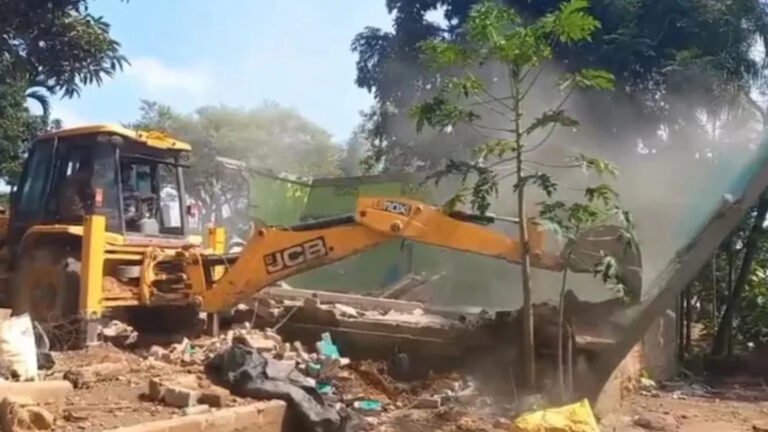
In July, the Assam government undertook a significant eviction operation in the Paikan Reserve Forest located in Goalpara district. This drive, which cleared more than 140 hectares of forest land, was launched in response to a Gauhati High Court order and marks a notable moment in the state’s long-standing effort to reclaim its ecologically sensitive spaces from illegal encroachment. The operation resulted in the removal of approximately 2,700 illegal structures and affected over 1,000 families.

The eviction was not an abrupt act. It followed months of notice and repeated communication, with authorities first issuing eviction notices in December 2024 and reiterating them in June 2025. By the time the operation began, over 95 percent of the encroachers had voluntarily vacated the area, which helped prevent large-scale confrontation and ensured the smooth execution of the eviction.

Understanding the Larger Context

Assam has one of the highest percentages of encroached forest land in India, with government estimates placing the figure at more than 3,600 square kilometers. Over the past few years, a concerted drive has been underway to recover these ecologically vital spaces. Since 2021, more than 25,000 acres of land—much of it categorized as reserved forests or critical wildlife corridors—has been reclaimed through state-led eviction drives.

The Paikan Reserve Forest lies in an area known for its frequent human-elephant conflicts. Unplanned and illegal human settlement in these areas has drastically reduced the roaming space for elephants, forcing them into human habitations, leading to loss of crops, injuries, and even human fatalities. Restoring these forest patches is therefore not just a conservation issue—it is also a matter of human safety.

The encroachment in Goalpara district had directly obstructed natural elephant corridors, contributing to an increase in conflict and ecological degradation. The eviction drive, therefore, sought to bring a degree of ecological balance back to a region that had become a flashpoint for environmental tension.

Legal, Ethical, and Ecological Rationale

The eviction was carried out under the orders of the Gauhati High Court, which had taken cognizance of the widespread encroachment on protected land. Over the years, the court has consistently directed state authorities to identify and remove encroachments from forest areas, citing not only legal violations but also the long-term ecological damage they pose.

The decision to clear the land was also rooted in the state’s broader vision to restore degraded forests and invest in biodiversity recovery. Officials have indicated that the reclaimed land in Goalpara will be reforested and may be used for bamboo plantations and other ecological restoration initiatives that benefit both wildlife and local communities.

Another important aspect to consider is the manner in which the eviction was carried out. Unlike earlier eviction drives in Assam, which were sometimes marred by clashes and controversies, the Goalpara operation was largely peaceful. Authorities coordinated with local communities, explained the legal framework, and gave sufficient time for residents to vacate the land. Law enforcement was on standby to maintain order, but resistance was minimal due to the preparatory steps taken by the administration.

Addressing Human Costs

No eviction is without human impact. Many of the families removed from the forest land had been residing there for years—some even decades—without formal land titles. Though the settlements were illegal, the humanitarian aspect cannot be ignored. At least one person attempted self-harm, and others expressed anguish over their uncertain futures.

This is where the state must step in to ensure balance. While it is necessary to enforce forest laws and protect the environment, it is equally important to provide support to displaced families, especially those who have no other place to go. Temporary shelters, access to welfare schemes, and assistance in rehabilitation are critical for ensuring that the evictions do not result in long-term suffering for vulnerable families.

The government has suggested that it will review the cases of those who have valid documents or long-term residency and extend support where appropriate. Such steps are essential to maintain a humane and just process.

Long-Term Gains: Ecological and Legal

From a conservation standpoint, the Goalpara eviction is a positive and much-needed development. By clearing encroached land in an ecologically sensitive zone, the government is sending a clear message that the misuse of forest land will not be tolerated. This is crucial in a time when biodiversity loss, deforestation, and climate change are accelerating.

Reclaimed land will help re-establish elephant corridors, reduce man-animal conflict, and allow native vegetation to recover. With proper planning and afforestation, the land can become part of Assam’s long-term environmental assets.

The drive also reinforces the authority of environmental and forest laws, which are often undermined by unauthorized settlements and political interference. Ensuring the rule of law in such areas builds a strong precedent for future governance and helps avoid the dangerous cycle of legal erosion and environmental degradation.

Moving Forward: What Needs to Be Done

To ensure that the eviction leads to sustainable outcomes, several critical steps must follow:

  1. Transparent Documentation
    The government must clearly delineate forest and revenue land boundaries, publish maps, and make information accessible to citizens to prevent future disputes.

  2. Clear Resettlement Plans
    Evicted families should be considered for legal resettlement, either through housing schemes or community relocation in less sensitive areas.

  3. Ecological Monitoring
    Reforestation and restoration efforts should begin promptly, with regular updates made public. Collaboration with environmental experts and local communities will be key.

  4. Community Engagement
    Engaging NGOs, local leaders, and civil society groups can help build public trust and ensure that both conservation and social justice goals are met.

  5. Education and Alternatives
    Educating local communities about the importance of forest preservation and offering them sustainable livelihood alternatives can reduce future encroachment pressure.

Conclusion

The Goalpara eviction drive reflects a significant moment in Assam’s efforts to reclaim its forests and realign human settlements with environmental priorities. While it has caused disruptions for some families, the long-term gains for biodiversity, wildlife safety, and ecological health are undeniable.

Critics may argue about timing or process, but the central idea remains valid: forest land is not merely vacant space; it is a shared resource for humans and wildlife alike, vital for maintaining ecological equilibrium. The decision to remove illegal settlements from such areas should be seen not as an act of displacement, but as an effort to restore order, legality, and sustainability.

If implemented with compassion and foresight, Assam’s eviction drives can become a model for balancing environmental protection with social responsibility—something that the entire country can learn from

Standing Tall at the Border: India’s Response to China’s Shadow Over Arunachal Pradesh

Nestled in the far eastern corner of India, Arunachal Pradesh is more than just a strategically sensitive border state. It is a land of rugged beauty, ancient Buddhist heritage, resilient tribal cultures, and proud Indian citizens. Yet, over the past few decades, this peaceful Himalayan region has found itself at the centre of a growing geopolitical storm.

China continues to claim the entire state of Arunachal Pradesh, referring to it as “South Tibet,” despite it being an integral part of India for decades. These claims, which are rooted in historical narratives rejected by India, have become more aggressive in recent years. Beijing’s moves—from renaming places on maps to building infrastructure near the Line of Actual Control (LAC)—have been viewed as deliberate provocations.

In response, India has taken a firm yet forward-looking stance. With a combination of military preparedness, rapid infrastructure development, and community empowerment, the country is not only defending its borders but also uplifting its people. And in Arunachal Pradesh, that dual strategy is playing out more visibly than ever before.

The Geopolitical Backdrop

Arunachal Pradesh has long been the subject of contention between India and China, especially the Tawang region, which holds deep religious and historical significance. China’s objections to visits by Indian leaders or Tibetan spiritual figures like the Dalai Lama to this area reflect an ongoing attempt to assert control. These political statements have been matched by actions—frequent reports of Chinese patrols crossing the LAC, construction of villages and roads on the other side, and diplomatic measures to deny visas to Arunachalis.

However, India’s consistent and clear position is that Arunachal Pradesh is, and will remain, an inseparable part of the nation. And the actions on the ground are now speaking as loudly as the words.

Military Vigilance: Eyes on the Sky, Feet on the Ground

India has enhanced its defensive posture in Arunachal Pradesh considerably in recent years. The Indian Air Force has strengthened aerial surveillance along the border, deploying drones and reconnaissance aircraft to monitor movements in high-altitude terrain. In addition, advanced air defence systems have been stationed to deter and respond to any aerial intrusions.

On the ground, the Indian Army has bolstered troop deployment along critical zones and conducted regular joint training exercises in the region. Specialized mountain warfare units, adapted to the unique terrain and conditions of Arunachal, ensure that India’s forces remain agile and effective. New helipads, bunkers, and logistics bases have come up in areas where even basic infrastructure was once absent.

These are not acts of aggression but rather essential steps to maintain peace and stability. By improving its military preparedness, India sends a clear message: It seeks peace, but will not be caught unprepared.

Infrastructure: Roads to Sovereignty and Development

Perhaps the most transformative element of India’s strategy is the rapid construction of border infrastructure in Arunachal Pradesh. For decades, this region was neglected in terms of connectivity, leaving vast stretches dependent on poor roads or inaccessible during winters.

That is changing dramatically.

Projects like the Sela Tunnel, which cuts through the snow-bound passes to provide year-round access to the strategically important Tawang area, symbolize the new vision for the Northeast. The tunnel not only reduces travel time but also ensures uninterrupted military and civilian movement.

The Trans-Arunachal Highway, stretching across the length of the state, is improving accessibility in remote districts, connecting border villages to district headquarters and larger markets. Meanwhile, new bridges over critical rivers and upgraded landing strips are reducing isolation and opening doors to tourism, trade, and better services.

India’s efforts go beyond military imperatives. The goal is to integrate Arunachal Pradesh fully into the national mainstream—economically, socially, and emotionally.

Vibrant Villages: Life Along the LAC

One of the boldest initiatives in the region is the Vibrant Villages Programme, launched to transform remote hamlets along the LAC into thriving communities. For too long, these villages lacked basic facilities, prompting people to migrate to towns or cities. China, in contrast, had been building what it calls “model villages” near the border to increase its presence.

India’s response has been people-centric. Under this programme, villages are being equipped with roads, internet connectivity, schools, health centres, and clean energy solutions. The idea is to make border residents partners in sovereignty by improving their quality of life and giving them reasons to stay and grow.

Tourism is also being encouraged in picturesque villages like Zemithang and Chumi Gyatse, both near the LAC. Visitors are now traveling to these sacred and scenic places, bringing revenue to locals and reinforcing Indian presence in areas that are both culturally and strategically significant.

Hydropower and Economic Sovereignty

Beyond roads and tunnels, the government is also investing in Arunachal Pradesh’s vast hydropower potential. The Upper Siang River and its tributaries present enormous opportunities for clean energy generation. New dam projects are being planned not just for electricity, but also to ensure water security and regulate river flow—a strategic move in light of China’s dam-building on the other side of the border.

While some concerns have been raised by local communities about environmental impacts, the government has pledged to ensure fair rehabilitation, local employment, and minimal ecological disruption. In many cases, village heads and residents have expressed support for these projects, viewing them as a pathway to progress.

How the Local People See It

Arunachalis have long lived with a sense of being on the periphery—not just geographically, but also in terms of national attention. That perception is beginning to shift.

Better roads mean easier access to hospitals, schools, and markets. Border villages that once relied on porters or mules now have jeeps and mobile connectivity. Younger residents are exploring entrepreneurship in tourism and agriculture, while elders report a renewed sense of security due to increased army presence.

Still, there are genuine concerns. Some communities worry about the cultural erosion that rapid development might bring. Others fear losing land or access to forests due to infrastructure projects. These are valid anxieties, and the state government has been urged to address them through transparent dialogues and inclusive planning.

However, the overwhelming sentiment in many places is that of cautious optimism. Residents feel proud to be at the frontline of India’s territorial integrity and appreciate the growing attention and investment from the central government.

A Strategic Balance

India’s policy in Arunachal Pradesh is increasingly seen as a mix of firm defence and soft power. It is not merely about matching China’s moves, but about reaffirming Arunachal’s Indian identity through visible development and local empowerment.

From diplomatic statements to parliamentary resolutions abroad supporting India’s territorial integrity, the international narrative is also tilting in India’s favour. Global partners are taking note of Beijing’s coercive tactics and voicing support for India’s peaceful and lawful claims.

Back home, Arunachal is evolving from a neglected borderland into a vital hub of strategic resilience, national pride, and inclusive development.

Looking Ahead

There is still a long way to go. Roads need to reach deeper into valleys, schools need better teachers, and healthcare must become more accessible. But the path has been set.

India’s long-term approach rests on three pillars:

  1. Security – Ensuring the LAC is well-guarded and border infrastructure supports both military and civilian needs.

  2. Development – Making Arunachal a model of sustainable and inclusive growth.

  3. Identity – Preserving and celebrating the state’s unique tribal cultures, languages, and traditions.

Arunachal Pradesh does not want to be known merely as a disputed territory. It wants to be seen as a dynamic, secure, and prosperous region that showcases India’s diversity and determination. And that is exactly the path the country is charting.

Conclusion

The story of Arunachal Pradesh is no longer only about border tensions or diplomatic deadlocks. It is increasingly a story of resilience—of how a border state is becoming a frontier of opportunity, connectivity, and national resolve.

India’s efforts to counter China’s influence in the region are not driven by aggression, but by a vision rooted in sovereignty, inclusivity, and development. And for the people who call this beautiful land home, that vision is beginning to bring tangible change.

In the face of provocation, India has chosen progress. In the face of intimidation, Arunachal stands tall—not as a pawn in geopolitics, but as a proud and peaceful sentinel of India’s eastern frontier.


Manipur on the Brink: Governance, Identity, and the Search for Peace

Manipur has endured a profound crisis since May 2023, triggered by ethnic tensions between the majority Meitei community in the Imphal Valley and the tribal Kuki-Zo communities of the hill districts. What began as a contentious debate over the extension of Scheduled Tribe status to the Meiteis spiraled into months of violence, massive displacement, and governance failures. From an Indian standpoint, the situation reflects deep challenges in regional administration, communal trust, and the need for national reconciliation.

Governance Crisis and Political Accountability

The initial unrest was ignited when the High Court directed consideration of Scheduled Tribe status for the Meitei community—a move seen by many Kuki-Zo leaders as a threat to their own social, land, and political rights. Clashes broke out almost immediately, escalating rapidly.

By July 2023, the conflict had claimed at least 175 lives, displaced over 60,000 people, and destroyed thousands of homes, churches, and temples. Communities became geographically and psychologically divided. Victims lived in relief camps, mostly in impoverished conditions, while trust between communities collapsed.

Government Reaction: Delayed, Defensive, Divisive?

Chief Minister N. Biren Singh and the state government were widely criticized for slow and selective responses. Opposition leaders accused the government of siding with Meiteis. Critics allege that security forces—CRPF, Assam Rifles—were seen as favoring one community or the other, undermining faith in institutions.

On 31 December 2024, Biren Singh addressed the media and said:

“I want to say sorry for what happened in the state. Many people lost their loved ones and many had to leave their homes. I regret and want to apologise.”
However, his apology received mixed responses—praise from some Meitei groups and rejection by many Kuki organisations as insufficient.

Earlier, on 6 October 2023, he had promised:

“Justice is being given to both communities… markets and offices have also been opened. I expect things to cool down soon.”

By mid-February, amidst growing unrest, he resigned, and the state was put under President’s Rule. Central forces were brought in, but their neutrality continued to be questioned.

Community Voices and Parliamentary Recognition of the Crisis

Many displaced Kukis declined state funeral honors and chose safe alternate routes for repatriation of their dead, citing fear and mistrust of Imphal. Thousands took shelter in neighboring districts and even states.

Parallel to political churn, civil society groups emerged. The Coordinating Committee on Manipur Integrity (COCOMI)—primarily representing Meitei interests—asserted that the unrest was rooted in demands for autonomous or separate administration. Meanwhile, the Indigenous Tribal Leaders’ Forum and other Kuki groups accused the administration of systematic targeting and demanded independent probes.

Union Defence Minister Rajnath Singh appealed to all communities, stating:

“Violence is no solution to any problem. What we need is heart‑to‑heart conversation.”

The Governor pledged concrete steps to resolve the crisis, highlighting temporary shelters, training programmes for displaced youth, and state support for artisans and handloom workers.

Where Governance Struggled, Civil Society Held Ground

Despite high-level assurances, formidable challenges persisted. Hundreds of militia-linked extortion cases were registered post-president’s rule. Sporadic incidents of violence—including beheadings and arson—continued to fuel fear. There were credible allegations of media bias, leading the Editors Guild of India to critique local reportage and demand depoliticized fact-finding.

Security operations were hampered by accusations that the CRPF and Assam Rifles showed partiality. Calls for greater transparency, faster relief, and impartial investigation became increasingly loud.

The Road Ahead: Towards Healing and Stability

1. Inclusive Dialogue

Rebuilding trust will require inclusive forums where Meitei and Kuki leaders engage transparently—not only with each other, but with the Centre. Dialogue should aim to resolve misgivings over land, quotas, identity, and political representation.

2. Community-led Rehabilitation

Relief camps must transition into long-term housing with livelihood programmes. Skill training initiatives underway should be scaled up, addressing trauma, loss, and interrupted education. Local youth and craftsmen need economic reintegration.

3. Neutral Security Oversight

Deployment of central forces must be accompanied by civilian oversight, transparent addressing of allegations of favoritism, and credible accountability mechanisms where law and order failed.

Date Event
3 May 2023 Violence erupts between Meiteis and Kuki-Zo following a court ruling on reservation status
5–June 2023 Over 170 killed, hundreds injured, thousands displaced; arson, assaults, and religious sites vandalized
July 2023 Video of Kuki women publicly paraded and assaulted sparks national outrage
August 2023 Kuki People’s Alliance withdraws support from ruling government; political division intensifies
September 2023 Editors Guild of India flags media bias amid escalating disinformation
Oct 2023 Chief Minister Biren Singh pledges justice for both communities
Feb 2024 Chief Minister resigns; President’s Rule imposed; central deployment of paramilitary forces underway
Jan 2025 CM issues formal state apology; reactions mixed between communities
Today Political regrouping with factions preparing to form a new government amid reports of continuing tensions

4. Media Ethics and Information Integrity

Fact-based reporting is essential in conflict zones. The state and media must commit to verifying information, avoiding sensationalism, and resisting the spread of inflammatory narratives.

5. Federal Engagement

Development must be prioritized in hill districts as well as the valley. Infrastructure, healthcare, education, and connectivity all need focus—especially to reinforce the message that governance extends evenly across Manipur.

Conclusion

Manipur’s turmoil reveals deeper fissures—identity politics, competing sovereignty claims, and fragile governance. The political situation is not merely a state’s failure, but a complex conundrum requiring nuanced federal action, healing leadership, and long-term vision.

From India’s perspective, the road to peace lies in combining firm governance with culturally sensitive diplomacy. The state’s future depends on its ability to reconcile divided communities, institutionalize justice, and offer equitable development.

An article like this serves not just as analysis, but as a call: to restore trust, rebuild communities, and reimagine Manipur as a symbol of democratic resilience—not division.

Assam Rifles Recover Huge Arms Cache in Arunachal Pradesh Operation

In a major security operation, the Assam Rifles recovered a large cache of arms and ammunition in Arunachal Pradesh’s Changlang district on July 17. The operation took place in the dense forest region near the Miao-Vijaynagar area, close to the Indo-Myanmar border, which is known for insurgent activity.

The seized items included several assault rifles, under-barrel grenade launchers, and hundreds of rounds of live ammunition. Officials said the arms were likely stockpiled by underground outfits operating in the region. The successful recovery is being seen as a blow to insurgent supply lines and a boost to counter-insurgency efforts in the eastern frontier.

Security forces have stepped up surveillance in the border areas following increased reports of cross-border militant movement. The operation was conducted based on specific intelligence inputs and involved coordinated efforts between local units and higher command. Further searches and investigations are underway to trace the source and intended recipients of the weapons.

Guwahati Emerges as Cleanest City in Northeast in National Survey

Guwahati has been ranked as the cleanest city in Northeast India according to the 2024–25 Swachh Survekshan survey. The city made a remarkable leap from its previous 402nd position to 44th place in the category of cities with a population of over 10 lakh. This improvement marks a major achievement for the Guwahati Municipal Corporation, which has been actively working to enhance sanitation and waste management practices across the city.

The survey assessed cities based on parameters such as door-to-door garbage collection, waste segregation, processing, and public feedback. Officials attributed the improvement to citizen participation, better solid waste systems, and focused urban sanitation campaigns. The recognition is seen as a boost for municipal reforms and as motivation for other cities in the region to follow suit.

Durand Cup 2025 to Begin on July 23, Northeast Hosts and Teams in Spotlight

0

The 2025 edition of the Durand Cup, Asia’s oldest football tournament, is set to kick off on July 23 and will continue until August 23. In a major expansion this year, matches will be hosted across five states, including three from the Northeast—Assam, Meghalaya, and Manipur. This is a significant move to promote football in the region, which has consistently produced promising talent and passionate fan bases.

The tournament will also see a record increase in prize money, with the pool tripled to ₹3 crore, underlining the growing stature and commercial appeal of the event. The expansion and increased investment are being seen as efforts to integrate regional football hubs into the national sporting narrative.

Several prominent teams from the Northeast are participating this year. Shillong Lajong from Meghalaya, KAMS and Bodoland from Assam, TRAU and NEROCA from Manipur, Rangdajied United from Meghalaya, and NorthEast United FC are all part of the tournament. Their participation not only boosts local enthusiasm but also reflects the rising standard of football in the region.

With the Northeast known for its deep football culture and enthusiastic spectators, the hosting of Durand Cup matches in Assam, Meghalaya, and Manipur is expected to draw large crowds and high energy. Organizers hope the event will serve as a platform for young players to shine and for the region to further establish itself as a footballing powerhouse in India.

Finance Minister Launches ₹1,500 Crore Development Projects in Meghalaya

Union Finance Minister Nirmala Sitharaman, who arrived in Meghalaya on a four-day visit on July 15, launched a series of infrastructure and development projects worth over ₹1,500 crore during her stay in the state. She is scheduled to conclude her visit on July 18.

The projects aim to strengthen the region’s economic and social infrastructure, focusing on improvements in sports, urban development, education, and industry. Among the major initiatives announced is the construction of a new football stadium to promote sports and youth engagement. The facility is expected to serve as a hub for both local and national-level competitions.

Sitharaman also launched smart city components in Shillong, including enhanced waste management systems, water supply upgrades, and better road infrastructure under the Smart Cities Mission. These developments are designed to improve urban living and boost digital governance.

As part of efforts to bridge the digital divide, the Finance Minister inaugurated several digital libraries and e-learning centers to support students and educators in both rural and urban areas. She emphasized the role of education and technology in shaping the future of the region.

The visit also included the announcement of policies to promote film tourism in Meghalaya, aiming to attract filmmakers by showcasing the state’s natural beauty and cultural diversity. Financial incentives and logistical support are planned to establish Meghalaya as a preferred shooting destination.

In addition, Sitharaman introduced schemes aimed at boosting agricultural exports and food processing. These are expected to benefit farmers and small enterprises by improving access to markets and enhancing production capabilities.

The initiatives announced during the Finance Minister’s visit are part of the central government’s broader strategy to accelerate development in the northeastern region and bring it at par with other parts of the country in terms of infrastructure, investment, and opportunity.