







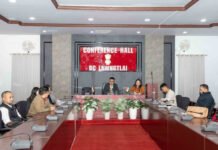




GUWAHATI: Union Home Minister Amit Shah on Friday presided over a high-level strategy meeting of the Bharatiya Janata Party (BJP) in Guwahati ahead of the forthcoming Assam Assembly elections. The gathering brought together top party leaders and organisational functionaries to review election preparedness, cadre mobilization and campaign strategies, as the BJP aims to retain power in the northeastern state.
Our correspondent reports that the meeting was held at a city hotel and saw participation from senior union ministers, state party office-bearers, key members of the National Executive, and BJP central observers appointed for Assam. The agenda included seat sharing prospects, booth management plans, public outreach programmes and issue-based campaign frameworks tailored to Assam’s socio-political landscape.
Amit Shah, who has been actively involved in the BJP’s electoral planning, emphasised the importance of a coordinated effort among the central leadership, state cadre and local workers to secure a decisive mandate for the party. He reviewed progress on voter connect initiatives and directed leaders to intensify field activities, particularly in areas where the party’s presence needs strengthening.
Addressing attendees, Shah underlined that the BJP would focus on key developmental issues such as infrastructure expansion, employment generation, welfare delivery and law-and-order improvements to win over voters. He also stressed the significance of cultural and identity issues that resonate deeply with the electorate of Assam, noting that understanding local aspirations would be crucial for electoral success.
The meeting involved detailed discussions on booth-level management, with cadres urged to engage more effectively with grassroots supporters. Party strategists presented data on past voting patterns and population demographics, which was used to identify priority regions where targeted campaigning could yield results. Leaders also reviewed feedback from recent public meetings and local surveys conducted across the state.
Our correspondent adds that union ministers and central leaders shared their perspectives on campaign messaging and outreach tactics. They highlighted the need for positive and inclusive messaging that emphasises the BJP’s achievements at both the state and national levels, including welfare schemes that directly benefit everyday citizens.
State party president and Assam’s Chief Minister, along with other senior members, outlined plans to expand alliance talks and engage with community leaders to build broad support bases. They discussed the role of youth and women’s wings in mobilising voters and the integration of digital campaigning tools to reach a wider audience.
Amit Shah was reported to have reiterated the party’s commitment to democratic values and transparent election conduct. He encouraged workers to prepare for robust but peaceful political engagement, reminding them of the constitutional framework within which the elections would take place.
The discussions also focused on addressing local concerns such as flood relief measures, agricultural support, rural development, job creation, and education infrastructure. Participants agreed that a clear articulation of policy priorities to voters would be essential to counter opposition narratives and strengthen the BJP’s position.
Senior party functionaries told reporters after the meeting that the BJP was ready to take on the challenge of the upcoming Assembly elections with a well-defined strategy. They expressed confidence that the party’s performance in governance and ability to communicate its vision effectively would resonate with the electorate.
Political analysts observing the developments in Assam noted that the BJP’s organisational push signified its intent to build momentum early in the election cycle. With the elections approaching, strategic coherence among central and state leadership was seen as a key factor that could tip the balance in the BJP’s favour.
The meeting concluded with Amit Shah emphasising thorough follow-ups and regular reviews to ensure that implementation of plans on the ground kept pace with the party’s strategic aspirations. Leaders were tasked with returning to their respective regions to fully activate the campaign machinery and engage with voters ahead of the formal campaign period.